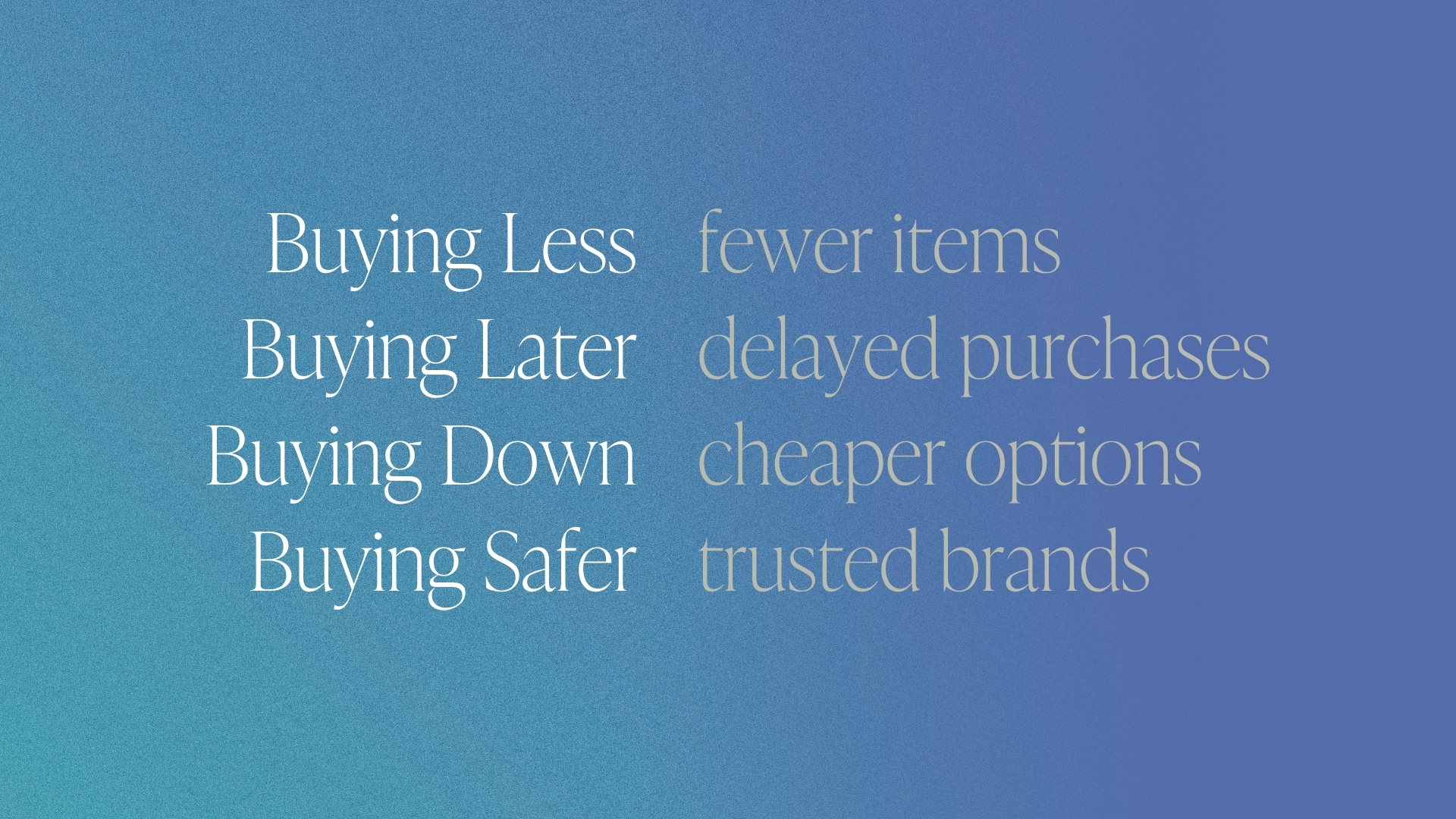
Major purchases are rarely straightforward. Buying a home, taking on a renovation, or switching to a new supplier takes real time, effort and risk.
We refer to these as high-involvement purchases and they share a few defining characteristics:
- They require significant research
- They carry meaningful perceived risk
- The outcome often has an impact beyond the immediate purchase
- There’s usually more than one person involved in making the decision
When markets are uncertain, all of this intensifies. Buyers scrutinise every dollar more carefully, the stakes of getting it wrong feel higher, and the research process gets longer.
Understanding how that changes buyer behaviour, and what it means for marketing, is important for all marketers in complex purchase categories.
Buying Less
When times feel uncertain, people buy less. This isn’t purely a budget issue. Even buyers who can technically afford what they were planning to spend will often pull back, because tightening the budget feels right when the future is unclear.
McKinsey research found that 69% of consumers cut discretionary spending or stop buying altogether during difficult economic periods
The psychological mechanism is loss aversion. We feel losses roughly twice as acutely as we feel equivalent gains. When financial stress rises, protecting what we already have becomes more compelling than acquiring something new. So the cash in our banks feels more valuable than what it can buy us.
What to do:
- Lead with what people get, not what they spend. Frame their decision around value
- Make the value tangible and specific. Someone scrutinising every dollar needs to understand concretely what they’re paying for, not an aspirational promise
- Give people a way to start smaller. A modular offer or tiered scope lowers the barrier to beginning without requiring full commitment upfront. Your goal here is to get buyers to say ‘yes’ to something, even if it’s only a small first step, and then build their lifetime value over time
- Show the cost of doing less. Help people understand what a reduced scope might mean for their result
What not to do:
- Lead with premium positioning and assume the value is obvious. Make it explicit
- Mistake a smaller budget as low intent. The person is still looking to buy, they just need a different entry point
- Cut brand spend. Staying visible during downturns consistently outperforms going quiet
Buying Later
The most visible behavioural shift in an uncertain market is to delay decisions. Longer lead time, more consultations, ‘hot’ prospects going quiet.
For high-involvement categories, this compounds an already long buying journey. A buyer who was six months from a decision and pushes it back another six is still in the market, but they’ve just become very hard to forecast.
The psychological term is status quo bias. By nature we prefer the current state of affairs over change, even when it’s objectively beneficial. In buying terms, we would rather deal with the problems we know we have now, than risk the unknown problems making a major purchase might bring. When the future is uncertain, the perceived risk of change is greater, reinforcing the ‘safety’ of the status quo.
What to do
- Stay visible. The brand someone remembers when they’re finally ready to buy is the one they’ll call. That familiarity is built through consistent presence, not a spike of activity when the market turns
- Nurture the relationship to build long term trust. Free consultations, useful content, comparison guides – anything that helps your buyer and helps you build trust while someone is waiting. For high value prospects, invite them to an event or check-in without any hard ask
- Be explicit and honest about any genuine urgency. Genuine stock availability or impending price changes can give people a legitimate reason to act now rather than later, without feeling exploitative
What not to do
- Manufacture urgency. People in a cautious mindset can spot pressure tactics quickly, and they’re more likely to disengage entirely than be persuaded
- Reduce marketing because sales are quiet. Brands that pause during slow periods have to rebuild from scratch when conditions improve, and when things are quiet you actually need effective marketing more than ever
- Treat silence as a no. People waiting to make their decision will be ready to buy at some point in the future. What do you want them to think about you when they do?
Buying Down
When money feels tight, people switch to better value alternatives. This isn’t always the cheapest option – it often involves weighing price against quality, reliability, and the risk of a poor purchase.
Quite often this effect is felt hardest for mid-market brands. Premium brands often have a functional advantage or an established brand that means a portion of buyers will default to buying them (see Buy Safer below).
At the other end of the spectrum, affordable brands have a price advantage and capture the lion’s share of price-conscious buyers.
Mid-market brands are in the awkward middle. Not a valuable enough competitive advantage, and not the cheapest offering.
A psychological factor in buying down behaviour is mental accounting. We mentally assign budgets to categories, and when financial pressure rises, we adjust those mental budgets. What felt like the right amount six months ago to spend on a new car, house or software now feels hard to justify. In many cases we convince ourselves the cheaper option is sensible rather than a compromise.
What to do
- Have a genuine entry point. A smaller scope that still demonstrates what you can do gives people a way in without full commitment upfront. Those relationships tend to grow.
- If you’re the premium brand, be explicit about the value you provide and help them understand what they’d lose if they went with a cheaper alternative. Use proven ROI as your metric
- If you’re the cheaper brand, foster the conversation about cost by clearly outlining your cost and inclusions. Show where you match and beat more expensive competitors
- Show work across different budget levels. Case studies aren’t just for your biggest and best projects.
What not to do
- Discount aggressively, unless you absolutely have to. Dropping prices to compete on cost anchors to that number and makes your standard pricing harder to defend
- Make someone feel like their budget is the problem. Serve them well at whatever level they’re at. A good experience at a smaller scope often leads to a bigger opportunity in future
Buying Safer
When the market is unpredictable the perceived risk of complex purchases is higher. So buyers stick with what they know. Choosing an established brand reduces the risk of getting it wrong.
An established brand is usually one you have interacted with for a long period of time, has a proven history of performance, a large existing customer base with social proof and an assumption of scale that legitimises the business. Essentially, established brands give you plenty of reasons to justify your decision.
In a nervous market, that matters more than it usually does. This “flight to safety” pattern is well-documented in financial markets and consumer purchasing studies.
VML’s Future Shopper 2025 research found that risk-averse shoppers are more selective and more research-driven, and more likely to reward brands that are consistent, transparent, and predictable.
In high-involvement categories where risk, complexity and potential impact are already high, that tendency becomes stronger.
This is risk aversion working in combination with what psychologists call the affect heuristic. We use our emotional response to a brand as a shortcut for assessing reliability. Familiar names feel safer by default because we have memories of them showing up consistently in a variety of contexts over a long period of time.
What to do
- Trust-building is the name of the game. This means actively managing your reputation rather than treating it just as an outcome of doing good business (although you can’t build trust without doing that)
- Make your social proof easy to find and easy to read. Client reviews, testimonials, and case studies should be easily available
- Borrow credibility where you can. Industry body membership, media coverage, and recognisable client names all help you look like a business that can be trusted
- Be transparent about how you work and what people can expect. A clear process shows your experience handling similar situations and reduces uncertainty
What not to do
-
- Rely entirely on referrals. Word of mouth should always be an important source for well-run businesses, but it’s slow and only reaches people who already know someone who knows you
- Cut price to lower the risk. In many cases cutting price can actually add to the risk – why are you cutting the price? Why weren’t you charging this price before?
- Disappear. Trust is built through consistency, not spikes in activity when things turn around
Pulling it all together
Uncertain markets don’t rewrite the rules of good marketing. They raise the cost of getting them wrong. Each of the four patterns covered here points to a different problem, and they often appear at the same time in the same market.
The businesses that navigate it best are the ones that understand which pattern is affecting their buyers and respond to that, rather than continuing to market as if conditions haven’t changed.
If you’d like help working through how current market conditions are affecting your marketing strategy, please reach out.
Cited Sources:
1. McKinsey & Company. “The Great Uncertainty: US consumer confidence and behavior during inflationary times.” (https://www.mckinsey.com/capabilities/growth-marketing-and-sales/our-insights/the-great-uncertainty-us-consumer-confidence-and-behavior-during-inflationary-times)
2. VML. “Economic & political uncertainty: Reshaping spending habits.” (https://www.vml.com/insight/future-shopper-economic-uncertainty-consumer-spending)